Every language model is European these days. Ask a follow-up question and you find a data centre in Frankfurt run by a company from Seattle. Anyone making decisions about generative AI this autumn hears the same three words everywhere: open, European, sovereign. What those words mean? The vendor decides. A report by the Dutch research organisation TNO, published in August 2026, now puts a clear yardstick next to them [1, 2].
Why “open” and “European” suddenly appear everywhere
TNO investigated, on behalf of the Dutch Ministry of the Interior (BZK), what “open” and “European” actually mean for language models [1, 2]. The trigger is geopolitical. The Dutch Digitalisation Strategy demands more control over digital dependencies. Language models are the newest layer in a software stack that already sits largely outside Europe. The conclusion is sharp. There is no unambiguous definition of an “open” language model, and “European” can be read in at least four ways [1]. Vendors make clever use of that [1]. TNO calls it “open-washing”, “Europe-washing” and “sovereignty-washing”, and advises public bodies to set their own working definitions before procurement starts [1]. It is a familiar scene in municipalities and public agencies. The buyer asks whether the model is open; the vendor nods. The CISO asks where the data is stored; silence. The questions below let you steer that conversation.
Open is a spectrum, not a switch
TNO distinguishes five degrees of openness, three of which are common in practice [1]:
- Closed model: you use it only through an API. Size, training data and data processing remain secret (for example GPT from OpenAI) [1].
- Open-weight model: you receive the model weights [1]. You can run and fine-tune it yourself, but you do not see the training data or the process (such as Llama and Mistral) [1].
- Fully open model: also releases the training data and source code (such as the Swiss Apertus) [1].
The crucial nuance sits in the middle category. Open-weight is what most “open” models really are. That has value: you can host it yourself and keep control of your data. But you still do not know exactly what is inside. When a vendor calls its model “open source”, it almost always means open-weight. Question 1: which degree of openness does this model have exactly, and what can I verify myself?
A European language model is four questions, not a tick box
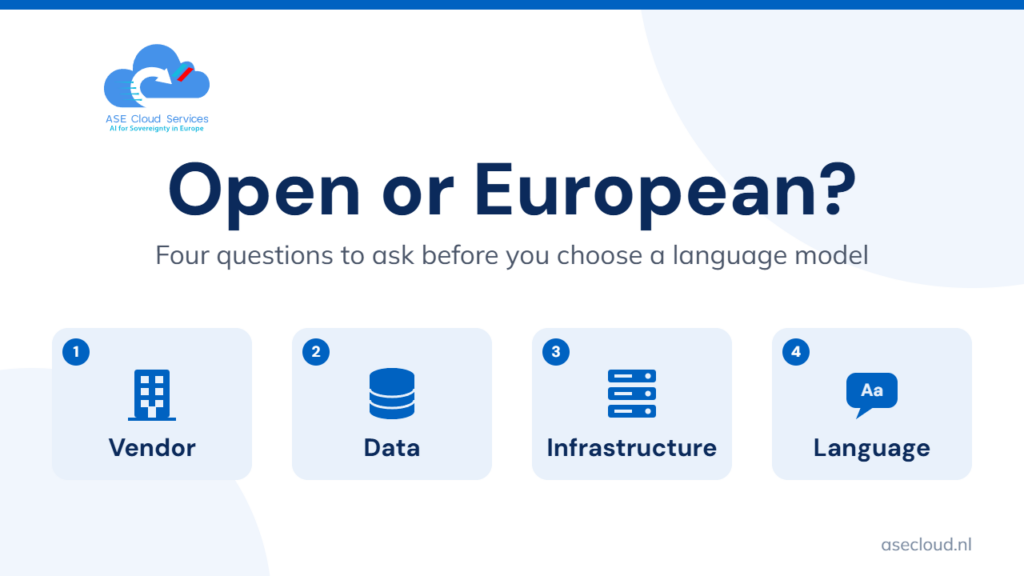
In the report, TNO uses an assessment table with four separate criteria [1]:
- Origin of the vendor: does the organisation fall under EEA jurisdiction, or under foreign legislation such as the US CLOUD Act [1]?
- Data location: where is data stored and processed [1]?
- Infrastructure: on which hardware does the model run [1]?
- Language base: has the model demonstrably been trained on European languages, including your own [1]?
A model from a European company on a US cloud is not sovereign, TNO states plainly [1]. Conversely, an open European model guarantees nothing if the hardware comes from the US [1]. And a model is not yet an application: the chatbot you use consists of an entire chain [1]. So put these four questions to the whole chain. Where is the organisation based? Where is the data? Where does it run? Was the model deliberately trained on your language, or does it know it by accident? A vendor that gives clarity on all four points is rare. A vendor that hesitates on one point shows you straight away where the risks are.
Our own choices, and their downside
A story about clear choices only works if we put our own cards on the table. The IRIS AI Platform from ASE Cloud Services runs on Mistral Small, an open-weight model under an Apache 2.0 licence from a French company. On TNO’s four questions it scores as follows: vendor in the EEA, data stored in our own cloud environment at OVHcloud (Gravelines and Strasbourg), infrastructure within the EU, and trained on European languages. But TNO also names the risks of exactly this choice [1]. Mistral offers open-weight models with limited insight into the training data, and there is an ongoing risk of acquisition by non-European investors [1]. You absorb that risk in the architecture around the model. The model itself has been made replaceable. The customer’s knowledge base sits in an isolated RAG layer, no training takes place on customer data, and everything rests on open standards. Switch models, and the knowledge base simply stays where it is. Because the model is open-weight, the customer chooses where it runs. We deliver the application in four variants: through the Mistral API, in our EU cloud, in the customer’s own cloud environment, or on-premises. That choice belongs with the organisation, not with the vendor. That is how you avoid vendor lock-in. Whoever keeps data, hosting and the application layer under their own control can switch as soon as a better model appears.
The smallest first step
You do not have to migrate right away. Take these four questions to your next vendor meeting and put them to your current suppliers too. Record the answers, including sources. That immediately becomes the file for your board, procurement and regulators, and it lays the foundation for the working definition TNO recommends [1]. TNO’s assessment table is publicly available on open.overheid.nl [2]. Want to apply these questions to your own situation? In a free 30-minute consultation we walk through the options. See AI Consulting Services for more information. If you first want to establish whether your AI governance can support the choice of a model, the GAP Assessment maps that out in 40 to 60 hours. And if you want the chosen model to work directly on your own documents, the AI Workspace Assistant does exactly that.
Sources
- TNO (2026). Open en Europese taalmodellen bij de overheid: definities en afwegingen (Open and European language models in government: definitions and considerations). Report TNO-2026-17545, August 2026 (in Dutch). https://open.overheid.nl/details/6ba92fae-f8e6-48f0-a5d2-bf334b14ac5e
- Digitale Overheid (2026). Verkenning inzet open en Europese taalmodellen bij overheid, 1 September 2026 (in Dutch). https://www.digitaleoverheid.nl/nieuws/verkenning-inzet-open-en-europese-taalmodellen-bij-overheid/

